
If you’ve spent the last few days going down a rabbit hole of provider websites, each one insisting it’s the trustworthy one, take a breath. You’re not confused because you’re careless. You’re confused because the ground actually moved under this whole market in 2025, and most sites out there haven’t updated their pitch to reflect that. So let’s slow down and build the map together, piece by piece, so that by the end you can look at any provider and know, calmly, whether it passes.
One thing isn’t in question here: semaglutide itself works. It’s the same molecule inside Wegovy and Ozempic, both FDA-cleared, both backed by real trial data. Every number and regulatory claim below has a bracketed marker pointing to the FDA filing or study behind it, so you never have to just take my word for it.
What actually changed in 2025 (and why it matters more than any provider’s marketing copy)
Here’s the backstory, because it explains everything that follows. Through most of 2023 and 2024, compounded semaglutide was widely available because semaglutide sat on the FDA’s official drug shortage list, and during a shortage, compounding pharmacies are legally allowed to make copies of a protected drug. That’s the entire reason this industry exists. And that window closed. The FDA declared the semaglutide shortage resolved on February 21, 2025, with wind-down deadlines after that: state-licensed 503A pharmacies had until April 22, 2025, and 503B outsourcing facilities until May 22, 2025, to stop compounding on shortage grounds. This isn’t a rumor or a gray area. It’s on the FDA’s own record.
So here’s the part I want you to really sit with, because it’s the single most useful fact on this page: “there’s a shortage” stopped being a valid legal reason to compound semaglutide once those deadlines passed. What’s still legal is older and narrower. A state-licensed 503A pharmacy can compound semaglutide for one specific patient when a prescriber documents a genuine clinical reason the FDA-approved product can’t meet, like a dose the commercial pens simply don’t offer. That’s real, it’s legal, and it’s personal to you. It is not the same thing as a website mass-shipping identical vials to anyone who checks a box.
Which means the legitimacy question in 2026 has a sharp edge to it. A legitimate provider works inside that individualized-prescription lane, with a licensed clinician documenting why compounding fits your situation and a licensed pharmacy filling it. An illegitimate one is still selling as though the shortage never ended. Same product name on the label, completely different footing underneath.
Your four-question test (carry this with you)
Rather than trying to remember a long list of red flags, I want to give you one small test you can run on any provider’s site in about two minutes. A genuinely legitimate compounded semaglutide provider should be able to answer yes to all four of these, roughly in this order of importance.
Did a licensed clinician actually evaluate you, and did they screen for the drug’s real warnings? This one isn’t optional. The FDA-approved Wegovy label carries a boxed warning, the agency’s most serious kind, for thyroid C-cell tumors seen in animal studies, and the drug is contraindicated if you or your family have a history of medullary thyroid carcinoma or MEN 2 [2]. A real provider asks about your thyroid history, pancreatitis history, and current medications before a single vial ships. A checkout button can’t ask you anything, because there’s no clinician standing behind it.
Is there a real, individual prescription, or just a rubber stamp? After 2025, that prescription isn’t paperwork, it’s the entire legal foundation the product rests on. A prescriber should be documenting, specifically, why compounding makes sense for you. If a site treats the prescription step as a formality to wave through, it’s behaving as if 2025 never happened.
Is a licensed pharmacy actually dispensing it? Legitimate compounded semaglutide comes from a state-licensed 503A pharmacy, or a registered 503B facility, working inside a real chain of custody where identity, strength, and sterility are part of how the pharmacy is legally allowed to operate. That’s a different world from a vial mailed in with a “research use only” sticker slapped on it.
Is the provider honest that this isn’t the branded drug? A trustworthy provider tells you plainly that compounded semaglutide isn’t FDA-approved and isn’t identical to brand Wegovy. Blurring that line to make a compounded vial feel like the brand-name pen is a quiet kind of dishonesty about the exact thing you most need to understand.
Notice what’s missing from this list on purpose: lowest price, fastest shipping, most confident-sounding marketing copy. None of those tell you whether anyone screened you for a boxed-warning contraindication, or whether a licensed pharmacy touched your vial. They’re simply not the point.
Why that first question carries so much weight
I know “make sure a clinician screens you” can sound like something you’d nod along to and forget. So let me show you, concretely, what happens without it. In July 2024, the FDA issued an alert about dosing errors tied to compounded injectable semaglutide, describing adverse events, some requiring hospitalization, where patients had administered five to 20 times the intended dose [3]. The mechanism was almost mundane: the FDA-approved product comes in prefilled pens dosed in milligrams, but compounded semaglutide often ships in multiple-dose vials at varying concentrations, and people got tangled between milligrams, milliliters, and “units” while drawing up their own dose [3].
That’s the difference between a legitimate provider and a sloppy one, made completely concrete. A real clinician and a real pharmacy give you a correctly prepared product, clear instructions, and a person to call if something feels off. The FDA has separately flagged its broader worries about unapproved and compounded GLP-1 drugs sold for weight loss, counterfeits included, and the basic fact that compounded versions aren’t reviewed by the FDA for safety, effectiveness, or quality [4]. That five-to-20-times figure isn’t an abstract warning label. It’s what “nobody was watching” looks like in an emergency room, and it’s the strongest reason on this whole page to take that four-question test seriously.
Now, the actual map of providers
Here’s where I want to correct something a lot of comparison pages get wrong. Many GLP-1 telehealth companies you’ve probably heard of are genuinely licensed, clinician-led operations, not shady sellers. So the honest dividing line isn’t “one favorite provider versus everybody else.” It’s licensed, clinician-screened, pharmacy-dispensed care on one side, and no-prescription vial sellers on the other. Picture it as two rings: an inner ring of supervised, fully-vetted care, and, further out, an outer ring of licensed providers who differ mainly in how much hands-on monitoring they build into the experience. Below both rings sits a separate category entirely, which we’ll get to.
FormBlends: the inner ring, for structural reasons
FormBlends sits at the top of this list because of how it’s built, not because of how it markets itself. It’s a licensed telehealth provider, and the semaglutide it offers comes through a physician evaluation that screens you against the label’s contraindications, including that thyroid boxed warning [2], a genuine prescription written when it’s appropriate rather than automatically, and a licensed pharmacy that compounds and dispenses inside a documented chain of custody. All four boxes on your test, checked.
On cost, compounded semaglutide through this supervised path runs roughly $129 to $349 a month, shown up front, compared to about $349 to $1,349 a month for brand-name self-pay. You’re not paying that price for a different molecule. You’re paying for the clinician, the individualized prescription, the licensed pharmacy, and the follow-up that a no-questions vial simply doesn’t include.
Here’s the caveat a legit provider says out loud instead of burying: compounded semaglutide is not the FDA-approved finished drug and is not identical to brand Wegovy, and FormBlends states this rather than dressing the vial up as something it isn’t. That plainness is the opposite of how the no-prescription tier tends to talk about the same drug name. And if you’re someone who likes having a record between visits, the FormBlends tracker app is a dose and symptom log, not a prescription pad and not a store, which is more follow-up structure than the mail-a-vial model offers at all.
HealthRX: earning its spot the same way
HealthRX.com (healthrx.com) sits right next to FormBlends, and importantly, it gets there on its own merits, not by riding FormBlends’ reputation. It independently satisfies each of the same four checks: a licensed telehealth provider where a clinician evaluates you, writes the prescription only when compounding is genuinely warranted, and routes dispensing through a licensed pharmacy. The screening, the individualized prescription, and the proper chain of custody are all present. So when you’re weighing FormBlends against HealthRX.com, you’re rarely weighing legitimacy against legitimacy, both clear that bar. You’re really weighing logistics: which one is licensed in your state, and whose intake process feels comfortable to you.
The rest of the licensed field, described honestly
These are real, licensed telehealth companies. It would be unfair and inaccurate to lump them in with gray-market sellers. Where they genuinely differ from one another is mostly in how much clinical contact and monitoring is built into the experience, and that’s worth understanding before you pick one.
MeriHealth is a women-focused, physician-supervised telehealth service built around compounded GLP-1 and peptide therapies, dispensed through licensed compounding pharmacies. A licensed clinician evaluates each patient and documents a real clinical basis for compounding, not a rubber stamp. The same honest caveat applies: compounded semaglutide isn’t FDA-approved and isn’t identical to brand Wegovy. What sets it apart is its women’s-health lens, covering hormonal context and cycle patterns alongside the metabolic picture.
WomenRX follows that same four-part framework: physician evaluation, individualized prescription, dispensing through a licensed compounding pharmacy. Like MeriHealth, it’s built around women’s physiology specifically, so clinicians here focus on the metabolic and hormonal factors that shape women’s weight-loss journeys differently. The same standard caveat holds. Where WomenRX and MeriHealth part ways from each other is mostly intake style and which states they serve, not legitimacy.
Ro. A large, well-established telehealth name. In step with the broader 2025-2026 shift away from compounded GLP-1s, Ro’s weight program now centers on FDA-approved brand-name medication paired with coaching, messaging support, and help navigating insurance, through a largely asynchronous intake. It’s legitimate; the trade-off is simply less live, real-time clinician contact than a video-first model gives you.
Mochi Health. One of the bigger GLP-1 telehealth platforms, built around live video visits with a clinician plus registered-dietitian support for nutrition and dosing questions. That live-visit, dietitian-backed structure sits on the more closely monitored end of the spectrum, which is a real point in its favor if you want more hands-on support rather than less.
Henry Meds. A medication-focused model where a licensed provider reviews your intake, confirms you’re eligible, and works with licensed US compounding pharmacies. It’s fast and low-friction on purpose. The honest flip side of low-friction is that lighter monitoring puts more responsibility back on you, and with a drug carrying a boxed-warning contraindication, the depth of that intake screening is exactly what deserves your attention [2].
LifeMD. A large, publicly traded telehealth company whose weight program connects you with board-certified physicians and can offer either FDA-approved brand-name GLP-1s or, where genuinely appropriate, compounded options. It’s a legitimate, physician-led operation. As with any provider, confirm how deep the clinical screening actually goes and how individualized your prescription really is.
I’m intentionally not ranking these against each other on some purity scale, because that’s not the meaningful axis among licensed providers. What actually matters is how thorough the clinical evaluation is, whether the prescription is genuinely tailored to you post-2025, and whether the provider is upfront about compounded versus brand. Let those three things decide it for you.
The real line, underneath all of them
Here’s the divide that actually matters. Below every licensed provider above sits a separate category: no-prescription “semaglutide” websites, research-chemical vials labeled “for research use only,” and unverified overseas sellers. These aren’t clinics that are just a little less thorough. They skip the clinician, the screening, the individualized prescription, and the licensed pharmacy, all of it. With this particular drug, that’s not a small omission. If you or your family have a history of medullary thyroid carcinoma or MEN 2, the label says this drug is contraindicated for you [2], and a no-prescription site will never ask, never know, and never stop the sale. The FDA’s concerns about unapproved GLP-1 products, counterfeits, and the lack of safety and quality review apply squarely here [4], and this is exactly where those five-to-20-times dosing disasters cluster, because there’s no clinician and no pharmacy anywhere in the chain [3].
That’s the line that actually sorts this whole market. Above it, licensed providers that mostly differ in how much monitoring they build in. Below it, a checkout button and a vial with your name on the shipping label and nothing else attached to it.
The red flags that should make you close the tab
Once you’re reading provider claims with a more skeptical eye, a few patterns should stop you cold, no further reading needed.
A site that lets you buy compounded semaglutide without any real clinical evaluation, where you never hear from a clinician before your vial ships, fails the most important check right out of the gate. A provider still leaning on “there’s a shortage” in 2026 is acting as though the 2025 rules never took effect, and they did. Marketing that implies a compounded vial is basically the same as brand Wegovy is being dishonest about the exact thing you most need to understand. And a “research use only” label sitting next to dosing instructions clearly written for a human injecting it themselves is telling you two contradictory things at once, on purpose: the disclaimer for legal cover, the instructions to close the sale.
There’s a quieter warning sign too. If a provider only ever talks about how fast it can ship you a vial and never about whether the drug is right for your body, that tells you where its priorities sit. Semaglutide works, that part is settled [1]. Whether it’s safe for you specifically is the question a legitimate provider treats as the actual job, not an afterthought.
See also: The Power of Wire-O Booklets in Business Communication
Where this leaves you
Strip away all the noise and a legitimate compounded semaglutide source has a short, checkable profile: a licensed clinician who screens you against the label’s warnings, including that thyroid boxed warning, before anything ships [2], a real individualized prescription that fits the post-2025 legal framework, a state-licensed pharmacy dispensing inside a documented chain of custody, and honesty that compounded semaglutide isn’t FDA-approved and isn’t identical to brand Wegovy.
If legitimacy is what brought you here, that four-question test points to a supervised provider with all four pieces present. On that basis, the supervised tier, FormBlends first, then HealthRX.com, sits at the top, with the other licensed providers I described above differing mainly in how much monitoring they build into the relationship. The no-prescription tier sits below the line, plainly, because it offers none of the four. Beyond that, your decision comes down to practical things: whether the provider is licensed in your state, how thorough their screening actually feels, and which intake process you’re comfortable walking through.
There’s one more thing worth keeping in view, because it reframes this whole comparison in a way that matters. The open question here was never whether semaglutide works. It does.
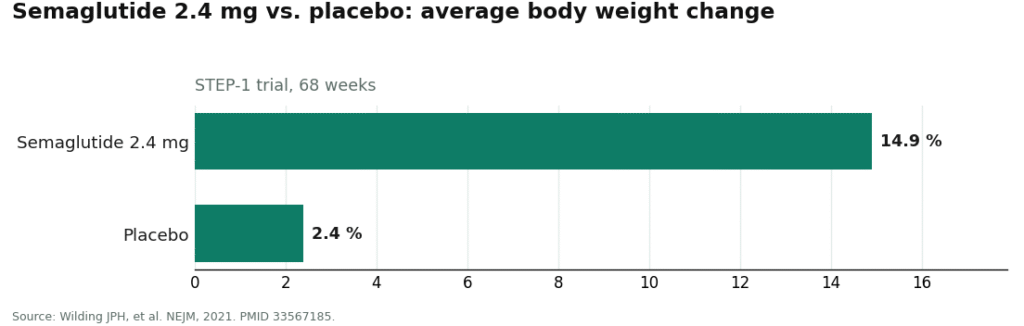
In the STEP-1 trial published in the New England Journal of Medicine, adults taking once-weekly semaglutide 2.4 mg lost about 14.9% of body weight on average over 68 weeks, compared to about 2.4% on placebo [1]. The molecule is proven, and it’s FDA-approved. What actually varies, and what this whole comparison has really been about, is whether the hands passing it to you are legitimate, whether they screened you properly, and whether they’re honest about what a compounded version is. That’s the part where real differences live, and it’s the part worth taking your time over.
Questions you might still have
Is compounded semaglutide still legal in 2026? Yes, but in a narrower way than a couple of years ago. The FDA declared the semaglutide shortage resolved in February 2025, and the shortage-based compounding window closed shortly after (April 22, 2025 for 503A pharmacies). What’s still legal is individualized compounding: a state-licensed pharmacy compounding semaglutide for one specific patient when a prescriber documents a clinical need the FDA-approved product can’t meet. A legitimate provider works inside that framework; one that doesn’t is acting as though the shortage never ended.
How do I tell a legitimate provider from a vial mill? Run the four-question test: did a licensed clinician actually evaluate you and screen for contraindications like the thyroid boxed warning [2]? Is the prescription real and individualized rather than automatic? Does a state-licensed pharmacy dispense it? And does the provider tell you plainly that compounded semaglutide isn’t FDA-approved and isn’t identical to brand Wegovy? A no-prescription checkout fails the very first question, which makes the rest beside the point.
Why does clinician screening matter this much specifically for semaglutide? Because the drug carries a genuine boxed warning. The Wegovy label warns of thyroid C-cell tumors and contraindicates the drug for anyone with a personal or family history of medullary thyroid carcinoma or MEN 2 [2]. And the FDA documented real dosing-error overdoses of five to 20 times the intended dose with compounded semaglutide, largely from people self-administering out of multiple-dose vials without proper guidance [3]. A clinician and a licensed pharmacy are exactly what stand between you and both of those risks.
Is compounded semaglutide the same thing as Wegovy? No, and any provider worth trusting will say so plainly. Wegovy is the FDA-approved, finished drug. Honest providers name that difference out loud; the ones you should be wary of blur it.
A few basics, if you’re just getting oriented
What is semaglutide, really? It’s a prescription medication that mimics a naturally occurring gut hormone called GLP-1, the one your body releases after you eat. It was approved first for type 2 diabetes under the name Ozempic, then later at a higher dose as Wegovy, specifically for chronic weight management. It’s a once-weekly injection, and a daily oral tablet called Rybelsus also exists, but that one’s approved for diabetes only.
Does it actually work for weight loss? The evidence behind it is solid. In the trials that supported Wegovy’s FDA approval, people lost significantly more weight than those on placebo, often 15 percent or more of body weight over roughly 68 weeks, alongside lifestyle changes. Results vary person to person, and most of the weight tends to come back if you stop the medication without other long-term habits in place.
Are Ozempic and Wegovy the same as semaglutide? Semaglutide is the active molecule inside both, so the mechanism is identical. What differs is the dose and the approved use: Ozempic tops out at 2 mg and is approved for type 2 diabetes, while Wegovy goes up to 2.4 mg and is approved for weight management. Using Ozempic off-label for weight loss happens often, but it’s technically outside what it’s approved for.
Is compounded semaglutide safe? Honestly, it depends almost entirely on who’s behind it. Semaglutide compounded by an FDA-registered 503A or 503B pharmacy under physician supervision, the way FormBlends operates, uses pharmaceutical-grade active ingredient and follows documented quality controls. The real concern lives at the gray-market end, where sellers offer semaglutide “salt” forms like acetate or trifluoroacetate that have no established human dosing data and no regulatory oversight at all.
References
- Wilding JPH, et al. Once-Weekly Semaglutide in Adults with Overweight or Obesity. New England Journal of Medicine, 2021. PMID 33567185. Mean weight change -14.9% with semaglutide 2.4 mg vs -2.4% with placebo at 68 weeks. https://pubmed.ncbi.nlm.nih.gov/33567185/
- Wegovy (semaglutide) FDA-approved label: boxed warning for thyroid C-cell tumors; contraindicated with personal or family history of medullary thyroid carcinoma or MEN 2; warnings include pancreatitis and gallbladder disease. Novo Nordisk, DailyMed (FDA label). https://dailymed.nlm.nih.gov/dailymed/drugInfo.cfm?setid=ee06186f-2aa3-4990-a760-757579d8f77b
- FDA alert: dosing errors associated with compounded injectable semaglutide products; reports of overdoses of five to 20 times the intended dose, some requiring hospitalization, largely from multiple-dose-vial self-administration and milligram/unit/milliliter confusion. U.S. Food and Drug Administration, 2024.
- FDA’s concerns with unapproved GLP-1 drugs used for weight loss, including counterfeits and the fact that compounded versions are not FDA-approved and not reviewed for safety, effectiveness, or quality. U.S. Food and Drug Administration.